
| Deutsche Version |  |
 |
| W | kW | kcal/s | kcal/h | kgf m/s | PS | HP | |
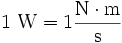
| 1 W = Nm/s = J/s | 1 | 0.001 | 2.39×10⁻⁴ | 0.860 | 0.102 | 0.00136 | 0.001359 |
| 1 kW = | 1000 | 1 | 0.239 | 860 | 102 | 1.36 | 1.3596 |
| 1 kcal/s = | 4190 | 4.19 | 1 | 3600 | 427 | 5.69 | 5.685 |
| 1 kcal/h = | 1.16 | 0.00116 | 0.00028 | 1 | 0.119 | 0.00158 | 0.001606 |
| 1 kgf m/s = | 9.81 | 0.00981 | 0.00234 | 8.43 | 1 | 0.0133 | 0.01335 |
| 1 PS = | 736 | 0.7360 | 0.176 | 623 | 75 | 1 | 0.98632 |
| 1 HP = | 735.5 | 0.7355 | 0.1759 | 622.577 | 74.905 | 1.01387 | 1 |
Conversions of many more power units
Calculation: electrical voltage, current, resistance, and power
Power conversion chart
| To convert from: | to: | multiply by |
| erg per second (erg/s) | watt W | 1.0×10⁻⁷ |
| foot pound-force per hour (ft·lbf/h) | watt W | 3.766161×10⁻⁴ |
| foot pound-force per minute (ft·lbf/min) | watt W | 2.259697×10⁻² |
| foot pound-force per second (ft·lbf/s) | watt W | 1.355818 |
| horsepower (550 ft·lbf/s) HP or BHP | watt W | 745.699872 W |
| horsepower (boiler) | watt W | 9809.50 |
| horsepower (electric) | watt W | 746 |
| horsepower (metric) = 75 kgf·m/s | watt W | 735.4987 |
| horsepower (UK) HP or Break HP | watt W | 745.699872 W |
| horsepower (water) | watt W | 746.043 |
Powerunits conversion chart
Sorted from small to large
| Name of Power Unit, P | Symbol | Definition | Relation to SI unit watt, W |
| watt (SI unit) | W | ≡ J/s = N·m/s | = kg·m²/s³ |
| lusec | lusec | ≡ 1 L·µmHg/s | ≈ 1.333 224×10−4 W |
| foot-pound-force per hour | ft lbf/h | ≡ 1 ft lbf/h | ≈ 3.766 161×10−4 W |
| atmospherecubic centimetre per minute | atm ccm | ≡ 1 atm × 1 cm³/min | = 1.688 75×10−3 W |
| foot-pound-force per minute | ft lbf/min | ≡ 1 ft lbf/min | = 2.259 696 580 552 334×10−2 W |
| atmosphere–cubiccentimetre per second | atm ccs | ≡ 1 atm × 1 cm³/s | = 0.101 325 W |
| BTU (International Table) per hour | BTUIT/h | ≡ 1 BTUIT/h | ≈ 0.293 071 W |
| atmosphere–cubic foot per hour | atm cfh | ≡ 1 atm × 1 cu ft/h | = 0.797 001 244 704 W |
| foot-pound-force per second | ft lbf/s | ≡ 1 ft lbf/s | = 1.355 817 948 331 400 W |
| litre-atmosphere per minute | L·atm/min | ≡ 1 atm × 1 L/min | = 1.688 75 W |
| calorie (International Table) per second | calIT/s | ≡ 1 calIT/s | = 4.1868 W |
| BTU (International Table) per minute | BTUIT/min | ≡ 1 BTUIT/min | ≈ 17.584 264 W |
| atmosphere-cubic foot per minute | atm·cfm | ≡ 1 atm × 1 cu ft/min | = 47.820 074 682 24 W |
| square foot equivalent direct radiation | sq ft EDR | ≡ 240 BTUIT/h | ≈ 70.337 057 W |
| litre-atmosphere per second | L·atm/s | ≡ 1 atm × 1 L/s | = 101.325 W |
| horsepower (metric) | hp | ≡ 75 m kgf/s | = 735.498 75 W |
| horsepower (European electrical) | hp | ≡ 75 kp·m/s | = 736 W |
| horsepower (Imperial mechanical) | hp | ≡ 550 ft lbf/s | = 745.699 871 582 270 22 W |
| horsepower (Imperial electrical) | hp | - | ≡ 746 W |
| ton of air conditioning | - | ≡ 1 t × 1005 J/kg × 1 °F/K ÷ 10 min | = 844.2 W |
| poncelet | p | ≡ 100 m kgf/s | = 980.665 W |
| BTU (International Table) per second | BTUIT/s | ≡ 1 BTUIT/s | = 1.055 055 852 62×103 W |
| atmosphere-cubic foot per second | atm cfs | ≡ 1 atm × 1 cu ft/s | = 2.869 204 480 934 4×10³ W |
| ton of refrigeration (IT) | - | ≡ 1BTUIT × 1 sh tn/lb ÷ 10 min/s | ≈ 3.516 853×103 W |
| ton of refrigeration (Imperial) | - | ≡ 1BTUIT × 1 lng tn/lb ÷ 10 min/s | ≈ 3.938 875×103 W |
| boiler horsepower | bhp | ≈ 34.5 lb/h × 970.3 BTUIT/lb | ≈ 9.810 657×103 W |
|
History of the term "horsepower" The term"horsepower" was invented by James Watt to help market his improvedsteam engine. He determined that a horse could turn a mill wheel 144 times in an hour (or 2.4 times a minute). The wheel was 12 feet in radius, thus in a minute the horse travelled 2.4 × 2π × 12 feet. Watt judged that the horse could pull with a force of 180 pounds (just assuming that the measurements of mass were equivalent to measurements of force in pounds-force, which were not well-defined units at the time). So: Conversion of historical definition to watts The historical value of 33,000 ft∙bf/min may be converted to the SI unit of watts by using the following conversion of units factors: |
| Break Horsepower is just another way to talk about SAE net horsepower − hp (SAE). Divide DIN 70020 horsepower by 1.0138695680991980 to arrive at SAE net horsepower. 1 PS = 75 kp×m/s = 735.49875 W = 0.9863201652997627 hp (SAE) |
|
The Power power = force * distance / time P = F * s / t |
back  |
next  |
home  |


 so the historical figure of 33,000 ft·lbf/min converts exactly to the modern definition.