
| Deutsche Version |  |
 |
| Gain is the ratio between the magnitude of output and input signals. Gain controls on an amplifier are basically just small potentiometers (variable resistors) or volume controls, that allow you to adjust the incoming signal to the amplifier. |
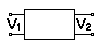
| V1 = Vin and V2 = Vout V2 > V1 or Vout > Vin means amplification. The dB value is positive (+). V2 < V1 or Vout < Vin means damping. The dB value is negative (−). V2 / V1 or Vout / Vin means the ratio. The amplification or the damping in dB is: L = 20 × log (voltage ratio V2 / V1) in dB. V1 = Vin is the reference. |
In physics, attenuation is regarded as a positive value.
This naturally leads to sign errors when entering numbers.
| 3 dB ≡ | 1.414 times the voltage | (−)3 dB ≡ | damping to the value 0.707 |
| 6 dB ≡ | 2 times the voltage | (−)6 dB ≡ | damping to the value 0.5 |
| 10 dB ≡ | 3.162 times the voltage | (−)10 dB ≡ | damping to the value 0.316 |
| 12 dB ≡ | 4 times the voltage | (−)12 dB ≡ | damping to the value 0.25 |
| 20 dB ≡ | 10 times the voltage | (−)20 dB ≡ | damping to the value 0.1 |
| Using voltage we get: Level in dB: L = 20 × log (voltage ratio) |
| 6 dB = twice the voltage 12 dB = four times the voltage 20 dB = ten times the voltage 40 dB = hundred times the voltage |
If we consider audio engineering, we are usually not interested in power.
Do not ask what power amplification means.
Leave that to the telephone companies or the transmitting aerials (antennas).
Power gain is really not used in audio engineering.
Do we really need power (energy) amplification?
Read the text at the bottom.
| 3 dB ≡ | 2 times the power | (−3) dB ≡ | damping to the value 0.5 |
| 6 dB ≡ | 4 times the power | (−6) dB ≡ | damping to the value 0.25 |
| 10 dB ≡ | 10 times the power | (−10) dB ≡ | damping to the value 0.1 |
| 12 dB ≡ | 16 times the power | (−12) dB ≡ | damping to the value 0.0625 |
| 20 dB ≡ | 100 times the power | (−20) dB ≡ | damping to the value 0.01 |
Using power we get: Level in dB: L = 10 × log (power ratio)
| 3 dB = twice the power 6 dB = four times the power 10 dB = ten times the power 20 dB = hundred times the power |
If you search for the amplification ratio, given the dB value,
then go to the program dB calculation
Amplification (Gain) and Damping (Loss)
| To use the calculator, simply enter a value. The calculator works in both directions of the ↔ sign. |
In audio technique the following "power or energy amplification " is rather unusual.
| Voltage/Pressure amplification ratio |
1 |
1.414 = √2 |
2 |
3.16 = √10 |
4 |
10 |
20 |
40 |
100 |
1000 |
| Increasing of x dB | 0 | 3 | 6 | 10 | 12 | 20 | 26 | 32 | 40 | 60 |
| Power/Intensity amplification ratio |
1 |
1.414 = √2 |
2 |
3.16 = √10 |
4 |
10 |
20 |
40 |
100 |
1000 |
| Increasing of y dB | 0 | 1.5 | 3 | 5 | 6 | 10 | 13 | 16 | 20 | 30 |
 |
|
|
|
| To use the calculator, simply enter a value. The calculator works in both directions of the ↔ sign. |
The voltage is always given as RMS value - but that is not valid for electric power.
There is also the reference power P0 = 1 milliwatt or 0.001 watt ≡ 0 dBm
Level in psycho acoustics as subjectivly perceived loudness (volume)
The vague human feeling of the double loudness (volume) is specified
with about 6 to 10 dB. This personal feeling is not an exactly measurable value.
| Conversion Factor, Ratio, or Gain to a Level Value (Decibels dB) Amplifier conversion – Convert decibels to voltage gain / loss Calculator Voltage Gain – Voltage Loss and Power Gain – Power Loss |
| Voltage gain  in dB in dB |
| Power gain  in dB in dB |
Voltage ratio 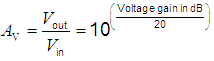 = amplification factor (voltage) = amplification factor (voltage) |
Power ratio 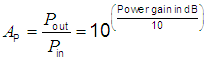 = amplification factor (power) = amplification factor (power) |
| V1 = Vin and V2 = Vout. V2 > V1 or Vout > Vin means amplification. The dB value is positive. (+) V2 < V1 or Vout < Vin means damping. The dB value is negative. (−) V2 / V1 or Vout / Vin means the ratio. The amplification or the damping in dB is: L = 20 × log (voltage ratio V2 / V1) in dB. V1 = Vin is the reference. |
 |
|
back  |
Search Engine  |
home  |