
| Deutsche Version |  |
 |
| ● 1 − Acoustic waves or sound waves in air ● Here are audio waves transmitted through air. For "radio waves and light waves" − scroll down ↓ Conversion: frequency f to wavelength λ and wavelength to frequency The speed of propagation c can be the speed of sound *or* the speed of light and radio waves. Sound waves are waves which propagate vibrations of air molecules. |
| If instead of the speed of light, the speed of sound in air c = 343 m/s at 20°C has to be used as speed of propagation, the following conversions apply. |
Calculator used with kind permission of DoctorProAudio.com |
| Sometimes when you switch from m to cm to ft and inch the answer is wrong the first time. Toggle between the changed values. Do a "refresh" and try again. |
Formulas and equations for sound: c = λ × f λ = c / f = c × T f = c / λ
| Physical value | symbol | unit | formula |
| frequency | f = 1/T | Hz = 1/s | f = c / λ |
| wavelength | λ | m | λ = c / f |
| time period or cycle duration |
T = 1/f | s | T = λ / c |
| wave speed speed of sound |
c | m/s | c = λ × f |
 |
Conversion of period to frequency and back
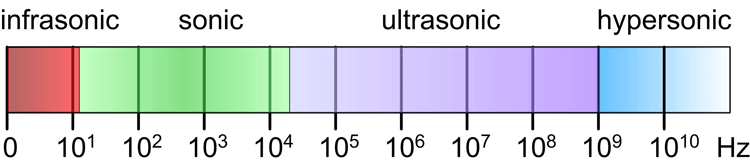 |
The top open range of the frequency spectrum for sound waves

| ● 2 − Radio waves and light waves in a vacuum ● Conversion: frequency f to wavelength λ and wavelength to frequency c is the speed of light waves and the speed of radio waves in a vacuum. The speed of light in free space (a vacuum) is the speed at which electromagnetic waves propagate, including light waves. |
| If instead of the speed of sound in air, the speed of light c = 299 792 458 m/s has to be used as speed of propagation, the following conversions apply. |
| Fill out the gray box above and click on the calculation button of the respective column. Choose the wanted unit. The proposed speed of light c = 299 792 458 m/s or 983 571 056 ft/s can be changed here. |
Formulas and Equations: c = λ × f λ = c / f = c × T f = c / λ
Wave frequency in Hz = 1/s and wavelength in nm = 10−9 m
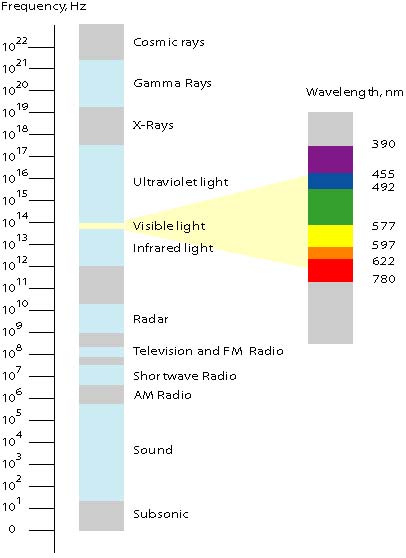 |
Electromagnetic Spectrum
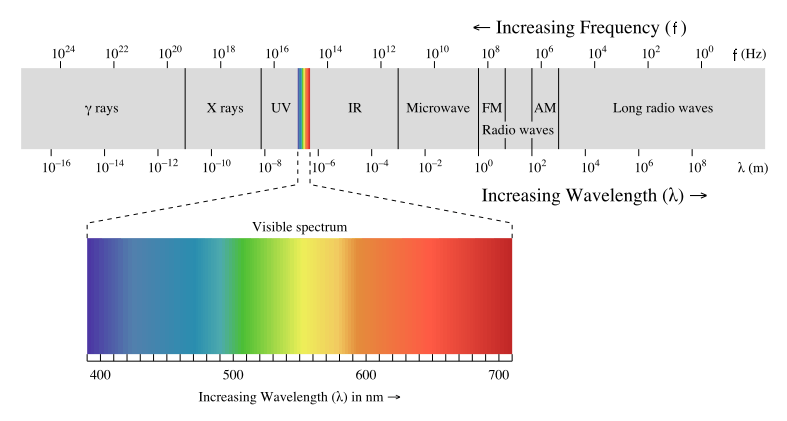 |
| Spectrum of electromagnetic radiation |
| Radio wave frequency and microwave radiation are both forms of energy called electromagnetic radiation. Sunshine contains three other forms of electromagnetic radiation: ultraviolet rays, infrared (heat) waves, and visible light waves. These electromagnetic waves spread in a vacuum at the speed of light ≈ 300,000 km/s as electromagnetic radiation. The propagation speed of electrical signals via optical fiber is about 9/10 the speed of light, that is ≈ 270,000 km/s. The propagation speed of electrical signals via copper cables is about 2/3 the speed of light, that is ≈ 200,000 km/s. In theory electrical signals move at the speed of light. Cables only slow them down. The velocity propagation factor (Velocity of propagation): VOP = 1 ⁄ √ε -epsilon is the dielectric constant, which is for polyethylene dielectrics (PVC) nearly 1.4. Sound is also shown at the spectrum chart, but it is no electromagnetic radiation. Sound pressure is the deviation from the local ambient pressure (sound pressure deviation) caused by a sound wave − mainly in air. The speed of sound is 343 m/s at 20°C in air. Sometimes the wavelength is still given in units of Ångström (angstrom): 1 Å = 10−10 m = 0.1 nm angegeben. |
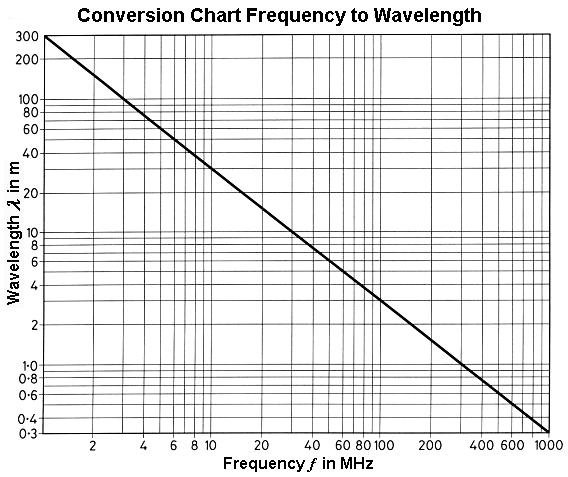
| Conversion Chart − Frequency to Wavelength |
 |
Spectrum of Electromagnetic Radiation
| Region | Wavelength angstroms |
Wavelength centimeters |
Frequency Hz |
Energy eV |
| Radio | > 109 | > 10 | < 3×10⁹ | < 10−5 |
| Microwave | 109 − 106 | 10 − 0.01 | 3×10⁹ − 3×10¹² | 10−5 − 0.01 |
| Infrared | 106 − 7000 | 0.01 − 7×10⁻⁵ | 3×10¹² − 4.3×10¹⁴ | 0.01 − 2 |
| Visible | 7000 − 4000 | 7×10⁻⁵ − 4×10⁻⁵ | 4.3×10¹⁴ − 7.5×10¹⁴ | 2 − 3 |
| Ultraviolet | 4000 − 10 | 4×10⁻⁵ − 10−7 | 7.5×10¹⁴ − 3×10¹⁷ | 3 − 103 |
| X-Rays | 10 − 0.1 | 10−7 − 10−9 | 3×10¹⁷ − 3×10¹⁹ | 103 − 105 |
| Gamma Rays | < 0.1 | <10−9 | > 3×10¹⁹ | >105 |
|
The notation "eV" stands for electron-volts, a common unit of energy measure in atomic physics. A graphical representation of the electromagnetic spectrum is shown in the figure below. |
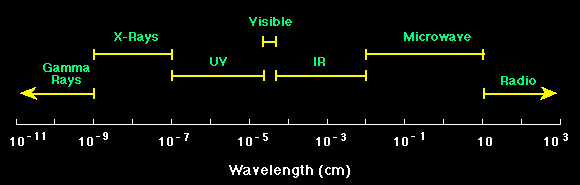 |
| Electromagnetic spectrum |
|
Thus we see that visible light and gamma rays and microwaves are really the same. They are all electromagnetic radiation and they just differ in their wavelengths. Sometimes the unit Ångström (angstrom) = 10−10 m = 0.1 nm is used for wavelength. |
Wavelengths and frequency ranges of colors
| Color |
Wavelength nm |
Frequency THz |
| red | 780 − 622 | 384 − 482 |
| orange | 622 − 597 | 482 − 503 |
| yellow | 597 − 577 | 503 − 520 |
| green | 577 − 492 | 520 − 610 |
| blue | 492 − 455 | 610 − 659 |
| violet | 455 − 390 | 659 − 769 |
|
1 terahertz (THz) = 103 GHz = 106 MHz = 1012 Hz, 1 nm = 10−3 μm = 10−6 mm = 10−9 m. White light is a mixture of the colors of the visible spectra. |
The indication of the frequency is less common in the optics.
| Sound waves and electromagnetic waves are different. Sound waves need a medium to travel through, while the electromagnetic waves do not. The properties of a sound wave depend on the properties of the medium it travels through. |
| Approximate speed of sound in common materials |
|||
| Medium | Speed of sound m/s ft/s |
||
| Air, dry at 20 °C | 343 | 1 125 | |
| Helium at 0 °C | 980 | 3 215 | |
| Hydrogen at 0 °C | 1 280 | 4 200 | |
| Water at 15 °C | 1 500 | 4 920 | |
| Lead | 2 160 | 7 090 | |
| Concrete | 3 100 | 10 200 | |
| Wood (soft − along the fibre) | 3 800 | 12 500 | |
| Glass | 5 500 | 18 500 | |
| Steel | 5 800 | 19 000 | |
| Ohm's law as acoustic equivalent for plane progressive waves Conversion of sound units (levels) |
| Conversion of the radio frequency to wavelength and vice versa |
| To use the calculator, simply enter a value. The calculator works in both directions of the ↔ sign. |
| ● Electromagnetic waves need no transport medium. |
| Conversion of the acoustic frequency to wavelength and vice versa |
| To use the calculator, simply enter a value. The calculator works in both directions of the ↔ sign. |
| ● Sound waves or acoustic waves need necessarily a transport medium. |
| Overtones, partials and harmonics from fundamental frequency Keyboard, frequencies = Naming of musical notes, piano keys Frequency domain of musical instruments and voices |
back  |
Search Engine  |
home  |