| English version |  |
 |
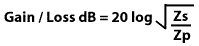
● Dezibel in Spannungsverstärkung Gain / Loss ●
● Spannungsverstärkung in Dezibel Gain / Loss ●
• Spannung und Gain •
| Zwei beliebige Werte sind einzusetzen - der dritte wird berechnet. |
 |
 U0 = 1 Volt |
| Einfach den Wert links oder rechts eingeben. Der Rechner arbeitet in beide Richtungen des ↔ Zeichens. |
Gain und Loss
|
Gain und Loss - Anhebung und Absenkung Spannung und Spannungspegel, sowie Schalldruck und Schalldruckpegel Gain is: Gain: The measure of how much a circuit amplifies a signal. Gain may be stated Conductive Hearing Loss: a loss of sensitivity to sound, resulting from an Gain or Loss: These are reciprocal numbers; they will be given in several ways. dB (decibel): A technique for expressing voltage, power, gain, loss, or frequency Voltage Controlled Attenuator (VCA): |
|
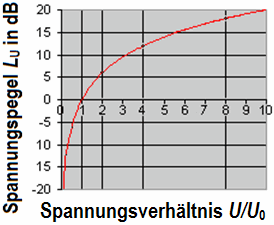
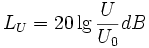
Darstellungsformen des Amplitudengangs: auf doppelt-logarithmischem Papier, als Verstärkungsmaß v = 20 · log Ua / Ue bzw. als Dämpfungsmaß a = 20 · log Ue / Ua = −v in dB (Dezibel) |
| Schallpegel, Lautheit und Schalldruck sind nicht das Gleiche. Es gibt Unterschiede in der Empfindung des Individuums bei des Stärke des Schall. Der Schalldruck, der doppelt so stark gemessen wird hat 6 dB mehr Pegel. Der Schall, der zweimal so laut empfunden wird, braucht etwa eine Pegelerhöhung von 10 dB. |
Gain und Loss ausgedrückt in Dezibel
Merke: Power gain (Leistungsverstärkung) wird in der Audiotechnik (Tontechnik) nicht verwendet.
| Gain/loss als Verhältnis (ratio out/in) |
Gain/loss als Faktor (factor) |
Gain/loss in dB als Feldgröße (Spannung) |
Gain/loss in dB als Energiegröße (Leistung) |
| 10000:1 | 10000 | +80.00 dB | +40.00 dB |
| 1000:1 | 1000 | +60,00 dB | +30,00 dB |
| 100:1 | 100 | +40,00 dB | +20,00 dB |
| 10:1 | 10 | +20,00 dB | +10,00 dB |
| 5:1 | 5 | +13,98 dB | +6,99 dB |
| 4:1 | 4 | +12,04 dB | +6,02 dB ● |
| 2:1 | 2 | +6,02 dB ● | +3,01 dB |
| 1:1 | 1 | 0,00 dB | 0,00 dB |
| 1:2 | 0,5 | −6,02 dB ● | −3,01 dB |
| 1:4 | 0,25 | −12,04 dB | −6,02 dB ● |
| 1:5 | 0,2 | −13,98 dB | −6,99 dB |
| 1:10 | 0,1 | −20,00 dB | −10,00 dB |
| 1:100 | 0,01 | −40,00 dB | −20,00 dB |
| 1:1000 | 0,001 | −60,00 dB | −30,00 dB |
| 1:10000 | 0,0001 | −80.00 dB | −40.00 dB |
40 dB Spannungs-Gain (Amplitude) ist 100 Mal der Spannungsfaktor (Amplitude).
40 dB Leistungs-Gain (Energie) ist 10000 Mal der Leistungsfaktor (Energie).
Spannungsverstärkung Voltage Gain und
Leistungsverstärkung Power Gain
| Spannungsverstärkung - Voltage Gain | Leistungsverstärkung - Power Gain | |||
| Spannungsverhältnis Faktor U2/U1 |
Spannungsverstärkung GV in dB |
Leistungsverhältnis Faktor P2/P1 |
Leistungsverstärkung GP in dB |
|
| 103 | +60 | 106 | +60 | |
| 102 | +40 | 104 | +40 | |
| 101 | +20 | 102 | +20 | |
| √10 = 3,16 | +10 | 10 | +10 | |
| 2 | +6 | 4 | +6 | |
| √2 = 1,414 | +3 | 2 | +3 | |
| 1 | ±0 | 1 | ±0 | |
| 1/√2 = 0,7071 | −3 | 1/2 = 0,5 | −3 | |
| 1/2 = 0,5 | −6 | 1/4 = 0,25 | −6 | |
| 1/√10 = 0,316 | −10 | 10−1 = 0,1 | −10 | |
| 10−1 = 0,1 | −20 | 10−2 = 0,01 | −20 | |
| 10−2 = 0,01 | −40 | 10−4 = 0,0001 | −40 | |
| 10−3 = 0,001 | −60 | 10−6 = 0,000001 | −60 | |
| V2/V1 = 10(GV in dB/20) | GV = 20·log (V2/V1) | P2/P1 = 10(GP in dB/10) | GP = 10·log (P2/P1) | |
 |
|
| Fragen: Für einen Verstärker mit einer100-fachen Spannungsverstärkung, berechne man das Folgende: a) Der Verstärkungspegel (Gain) in dB. b) Der Verstärkungspegel (Gain) bei der Grenzfrequenz in dB. c) Spannungsverstärkung bei der Grenzfrequenz. Antworten: a) Spannungsverstärkung 100 = 40 dB Voltage Gain b) Bei der Grenzfrequenz gibt es 3 dB weniger Gain - also 37 dB. c) Voltage Gain 37 dB = 70,7-fache Spannungsverstärkung. |
zurück  |
Suchmaschine  |
Startseite  |