
| Deutsche Version |  |
 |
| Zout is the source impedance Z2 (internal impedance) or the output impedance of the first audio device and Zin is the load impedance Z1 (external impedance) or the input impedance of the following device. Voltage bridging: Z1 >> Z2 or Zin >> Zout or Zload >> Zsource or Z1 >> Z2 in the audio world Power matching: Z1 = Z2 or Zin = Zout or Zload = Zsource or Z1 = Z2 in the radio frequency world |
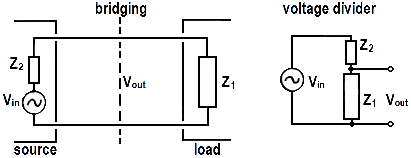 |
Interconnection of two audio units equals a circuit of a voltage divider − Z2 << Z1.
− No matching in audio −
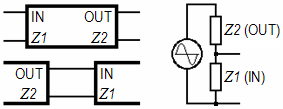 |
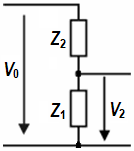
Attention: The numbering of the impedances is inversely to the resistors of a voltage divider.
Z1 = Input and Z2 = output.
 |
| Even in the sound studio the voltage bridging Z1 > Z2 will bring a level drop, depending on the difference between Z1 (Zin) and Z2 (Zout) with the bridging factor:  or in percent. Calculation of level damping (bridging): 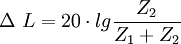 in dB. in dB.Calculation of the damping factor:  . .Bridging factor is not damping factor. |
See also: Calculations − voltage divider or potentiometer
and unloaded voltage divider
Different names of the two impedances Z1 and Z2
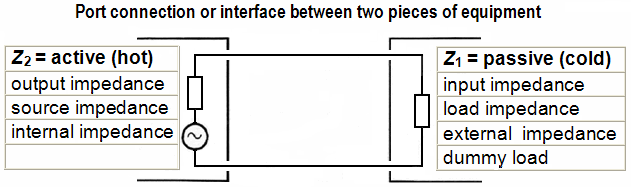 |
| If the load impedance is 10 times or more the source impedance, this
is called a "bridging" impedance. It results in maximum VOLTAGE transfer from the source to the load. If the load impedance equals the source impedance, this is called a "matching" impedance. It results in maximum POWER transfer from the source to the load. In the audio world we are happy with the maximum voltage transfer. But we are often confronted with fairy tale tellers teaching us the myth of power matching. Never believe that. |
The two impedances Z1 and Z2 at one device
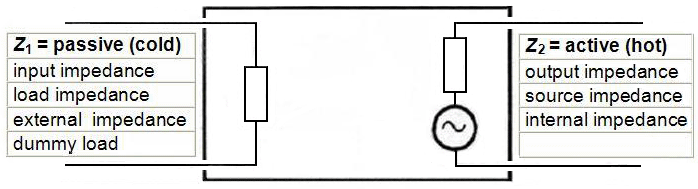 |
The impact of input impedance and output impedance
of studio gear for bridging in audio engineering
| In recording studio technique the microphone Zsource (Z2) is less than 200 ohms and Zload (Z1) of the mixer (pre-amp) is between 1000 and 2000 ohms. A voltage loss by attenuation of less than 1 dB is acceptable in professional audio engineering. The cable resistance (impedance) is a part of the output impedance of the amplifier. Because Voltage at the input of the amplifier = open-circuit voltage of the source × Zload/(Zload+Zsource) |
| There is no impedance matching Zout = Zin between power amplifier and loudspeakers. Power matching is a myth. We use voltage bridging Zout << Zin. The same goes for tube amplifiers whose output impedance is about one tenth of the speaker impedance. Thus we also have Zout < Zin. That's a fact! |
| In sound engineering there is no Power matching or Impedance matching. In audio we use only Voltage bridging or high Impedance bridging. |
The importance of input impedance and output impedance.
Thus means bridging of impedances in audio engineering
| The seldom specified source resistance Z2 (Zout) is hidden in the damping factor DF. A damping factor of at least DF = 100 is entirely in order. Analog studio devices have a source impedance Z2 of less than 40 ohms, with a load impedance of Z1 greater than 10 kiloohms. Zsource << Zload. Impedance matching (power matching) Z1 = Z2 on the other hand, is used in the telecommunications and the RF technology applied to antennas. |
The damping factor is usually given as numerical value, but also in decibels
| To use the calculator, simply enter a value. The calculator works in both directions of the ↔ sign. |
Calculation of the damping factor.
| How do I calculate the damping factor DF for example, at 1 kHz, if neither the
impedance of the source Z2 nor the impedance of the load Z1 is known? Allow the source to send out of a 1 kHz sine tone and measure the resulting voltage V0 at the output without any load. Then measure at this point the voltage VL, when the load is applied. The damping factor is: (V0 − VL) is the voltage drop by the connected load. |
|
Power matching or impedance matching Power matching is a connection of the electronics design practice for telephone lines and radio frequencies of setting the input impedance (ZL) of an electrical load equal to the fixed output impedance (ZS) of the signal source to which it is ultimately connected, usually in order to maximize the power transfer and minimize reflections from the load. ZL = ZS. This includes all digital device connections (interface). The other configuration, especially for audio and sound recording is an impedance bridging, voltage bridging, or simply bridging is a connection which maximizes the transfer of a voltage signal to the load. ZL >> ZS. Quite often this matching is erroneously demanded connecting the power amplifier to the loudspeaker. Where does this wrong "knowledge" come from? |
 |
Notice: There are no 4 ohm amplifiers. There are really no 8 ohm amplifiers for the 4 ohm or 8 ohm loudspeakers. |
| We got speaker impedance bridging. There is no speaker impedance matching. That is an ineradicable myth. The output impedance of the amplifier is always a tenth or a hundredth of the value of the loudspeaker impedance. The value of the output impedance of the amplifier Zsource is always hidden in the damping factor DF and can easily be calculated: Zsource = Zload / DF. Zload is the impedance of the loudspeaker. The cable resistance (impedance) is a part of the output impedance of the amplifier. Because of the high voltage of the source, cable screening (shielding) is here not necessary. The typical continuous query in the forums: "Can I use 4 ohm speakers to a 6 ohms amplifier?" (See reply under "Notice".) These issues show that there must be storytellers underway. How can we get rid of the nonsense of 2 to 16 ohms amplifiers? The output impedance of an amplifier Zout is always smaller than 0.5 Ohm. Zout << Zin. Amateurs are happy to speak of an 8 ohm amplifier, if they think that the amplifier output should be connected to "8 ohm speakers". Dealers use exactly these unclear expressions. In reality, the speaker impedance curve of a loudspeaker is never a straight line. |
| Impedance bridging Impedance bridging, voltage bridging, or simply bridging connection is a connection of the electronics design practice, especially for audio and sound recording, which maximizes the transfer of a voltage signal to the load. ZL >> ZS. This really also applies to loudspeakers. The other configuration especially for telephone lines antennas, and radio frequencies is a power matching (impedance matching) connection, which maximizes power delivered to the load. ZL = ZS. This includes all digital device connections (interfaces). |
| Fortunately, there are no amplifiers with an output impedance of
4-ohm or 8-ohm which have to fit to speakers with these values. We have no power matching, we have voltage bridging, whereby the power amplifier often has an output impedance of only one hundredth of the speaker's input impedance. At power amplifiers for musicians usually you can read at the output plugs: 4 ohms to 8 ohms − to tell the user that only a 4-ohm speaker or an 8-ohm speaker has to be used and not to give the "correct" output impedance value, which is around 0.1 ohms. This is not often known by users. |
 |
|
| In audio, electronics and acoustics use only the word "damping" and not the wrong word "dampening". (... or even better "attenuate"). "damping" means: 1. a decreasing of the amplitude of an electrical or mechanical wave. 2. an energy-absorbing mechanism or resistance circuit causing this decrease. 3. a reduction in the amplitude of an oscillation or vibration as a result of energy being dissipated as heat. "dampening" means: 1. To make damp. 2. To deaden, restrain, or depress. 3. To soundproof. Notice: Damping is energy dissipation and dampening is making something wet. |
| In the hifi and audio world amplifiers have only to amplify voltage and nothing else. At the amplifier input devices are connected to provide only weak audio voltages, such as CD players, turntables, guitars, synthesizers, microphones, tuners ... This low voltage (!) has to be amplified to provide the required high voltage to the loudspeaker. Who is talking in audio engineering of power (energy) at the input and output that has to be ampified, talks really nonsense. |
| If you don't like audio because you live in the RF world than go to "Impedance Matching": http://www.qsl.net/va3iul/Impedance_Matching/Impedance_Matching.pdf |
next  |
Search Engine  |
home  |