
| Deutsche Version |  |
 |
| Decibels are logarithmic "units", they may not be added linearly like other figures. In most cases we will add uncorrelated signals as noise or music. If a sound source creates a sound level (SPL) of L1 = 60 dB and another source with L2 = 60 dB is added, then it is not the level of 120 dB, but gives an incoherent (noncoherent) summing of the signal level of 63 dB. If both values are equal, it is easy. More than 3 dB greater than the higher of the two incoherent levels is not possible for the total sum in decibels. See also the other case: ● Total level adding of electrical coherent signals. |
Adding amplitudes (and levels)
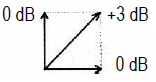 |
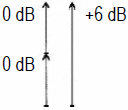 |
|
| Power sum incoherent (90°) √ (1² + 1²) = 1,414... |
Voltage sum coherent (0°) 1 + 1 = 2 |
Adding of two incoherent (noncoherent) sound pressure levels or voltage levels: Adding of two values of the same level results an increase of the total level of (+)3 dB. This equation is used for electrical adding of incoherent signals, and for the calculation of the energy level of two loudspeakers. Adding of two coherent sound pressure levels or voltage levels:  Adding of two values of the same level results an increase of the total level of (+)6 dB. This is obtained by feeding two side-by-side loudspeakers with the same signal. |
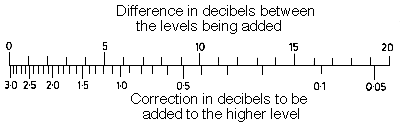 Level difference between the two sound sources |
Adding of two different acoustical levels
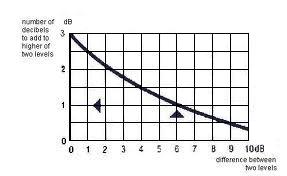 |
For the sound level of n incoherent radiating sound sources we get: p0 is the reference value of the sound pressure. Auditory threshold at 1 kHz = 0.00002 Pa = 20 µPa. |
Level adding of up to four sound sources

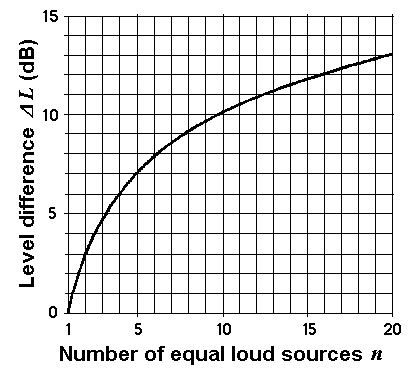
Adding of equal loud incoherent sound sources
 |
|
||||||||||||||||||||||||||||||
Formulas: Δ L = 10 × log n or n = 10(ΔL/10)
Δ L = level difference; n = number of equal loud sound sources.
| n = 2 equally loud incoherent sound sources result in a higher level of 10 × log10 2 = +3.01 dB compared to the case that only one source is available. n = 3 equally loud incoherent sound sources result in a higher level of 10 × log10 3 = +4.77 dB compared to the case that only one source is available. n = 4 equally loud incoherent sound sources result in a higher level of 10 × log10 4 = +6.02 dB compared to the case that only one source is available. n =10 equally loud incoherent sound sources result in a higher level of 10 × log10 10 = +10.00 dB compared to the case that only one source is available. |
Adding (combining) levels of equal loud sound sources
| To use the calculator, simply enter a value. The calculator works in both directions of the ↔ sign. |
The total level in dB is the level of one sound source plus the increase of level in dB.

|
See also: |
What does sound level mean?
A reduction of the sound power level of the sound source by 6 dB is resulting in a reduction of the sound
pressure level and the sound intensity level at the location of the receiver by also 6 dB, even if the sound
power drops to a factor of 0.25, the sound pressure drops to a factor of 0.5 and the sound intensity drops
to a factor of 0.25. The reference value for the sound level was chosen so that with a characteristic acoustic
impedance of Z0 = ρ · c = 400 N·s/m3 the sound intensity level results in the same value as the sound
pressure level. We therefore simply speak of the "sound level" and leave it open whether sound pressure
level or sound intensity level is meant.
|
back  |
Search Engine  |
home  |