
| English version |  |
 |
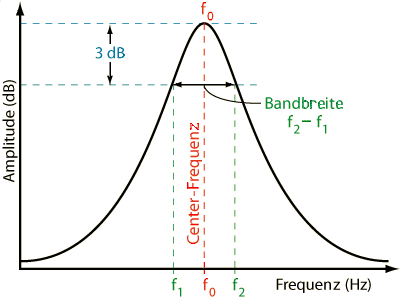 |
| Formel für die untere Grenzfrequenz: |
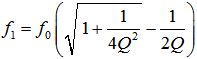 |
| Formel für die obere Grenzfrequenz: |
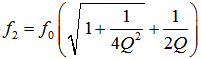 |
| Formel für den Q-Faktor: |
 |
| Formel für die Bandbreite: |
 |
| Eine hohe Filtergüte bedeutet schmalbandige Filterung (Notch), bei
großem Q-Faktor. Das ergibt steile Filterflanken bei kleiner Bandbreite. Eine geringe Filtergüte bedeutet breitbandige Filterung, bei kleinem Q-Faktor. Das ergibt flache Filterflanken bei großer Bandbreite. |
| Merke: Hoher Gütefaktor = kleine Bandbreite bzw. geringer Gütefaktor = große Bandbreite. |
Q-Faktor in Abhängigkeit von der Bandbreite in Oktaven N
| Bandbreite in Oktaven N |
Q-Faktor |
| 3,0 groß | 0,404 gering |
| 2,5 | 0,511 |
| 2,0 | 0,667 |
| 1,5 | 0,920 |
| 1,0 | 1,414 |
| 2/3 | 2,145 |
| 1/2 | 2,871 |
| 1/3 | 4,318 |
| 1/6 | 8,651 |
| 1/12 klein | 17,310 hoch |
| Warum wird die Bandbreite und die Grenzfrequenz mit dem Pegel "−3 dB" angegeben? Warum nehmen wir immer 3 dB nach unten beim Pegel eines Filters? Halbwertsbreite = Full width at half maximum - FWHM. Das ist der Punkt, an dem die Energie (Leistung) auf den Wert ½ gesunken ist oder auf 0,5 = 50 Prozent der ursprünglichen Leistung als Energiegröße, entsprechend (−)3 dB = 10·log(0,5). Ein (−)3 dB Leistungsabfall ist ein Abfall um 50% auf 50%. Die Spannung ist dabei auf den Wert √(½) gesunken oder auf 0,7071 = 70,71 Prozent der ursprünglichen Spannung als Feldgröße, entsprechend (−)3 dB = 20·log(0,7071). Ein (−)3 dB Spannungsabfall ist ein Abfall um 29,29% auf 70,71%. |
| (−)3 dB bedeutet ½ (die Hälfte) der Leistung. Da die elektrische Leistung proportional zum Quadrat
der Spannung ist, ergibt sich ein Wert von 0,7071 oder 70,71% der Durchlass-Spannung. √½ = 1/√2 = √0,5 = 0,7071. P ~ U2, also 0,5 ~ 0,70712. |
| Tontechniker und Sound-Designer ("Ohrenmenschen") verwenden gern die (Schall-)Feldgröße, darum heißt es: Die Grenzfrequenz eines Geräts (Mikrofon, Verstärker, Lautsprecher) ist diejenige Frequenz, bei welcher der Ausgangsspannungspegel auf einen Wert von (−)3 dB unter den Eingangsspannungspegel (0dB) gesunken ist. ● (−)3 dB entspricht dem Faktor √½ = 1/√2 = 0,7071. Das ist 70,71% der Eingangsspannung. Akustiker und Schallschützer ("Lärmbekämpfer") drücken dieses mit der (Schall-)Energiegröße etwas anders aus: Die Grenzfrequenz eines Geräts (Mikrofon, Verstärker, Lautsprecher) ist diejenige Frequenz, bei welcher der Ausgangsleistungspegel auf einen Wert von (−)3 dB unter den Eingangsleistungspegel (0 dB) gesunken ist. ● (−)3 dB entspricht dem Faktor ½ = 0,5. Das ist 50% der Eingangsleistung (die Hälfte). |
| Merke: Power gain - also Leistungsverstärkung - ist in der Audiotechnik (Tontechnik) nicht üblich. Selbst Leistungsverstärker für Lautsprecher verstärken keine Leistung. Sie verstärken die Audio-Spannung, welche die Schwingspule bewegt. |
Schallfeldgröße
 Schalldruck, Schallschnelle, Amplitude, Schallauslenkung, Spannung, (Stromstärke, elektrischer Widerstand). Reziprokes Abstandsgesetz 1/r |
Schallenergiegröße Schallintensität, Schallenergiedichte, Schallenergie, Schallleistung, (elektrische Leistung). Reziprokes Quadratgesetz 1/r² |
| Merke: Schallfeldgröße (Schalldruck p, elektrische Spannung U) ist nicht Schallenergiegröße
(Schallintensität I, Schallleistung Pak). I ~ p2 bzw. P ~ U2. Bisweilen hört man auch die Aussage: Die Grenzfrequenz liegt dort, wo der Pegel L, um (−)3 dB gesunken ist. Was immer der Anwender uns damit genauer mitteilen will: Pegel ist Pegel oder dB ist dB. |
Bandbreite beim parametrischen Equalizer von Yamaha
| Beim parametrischen Yamaha-Equalizer EQ ist eine Oktave in 60/60-tel Bandbreite (12 Halbtöne) eingeteilt, wobei ein Halbton dann 60/60:12 = 5/60 ist − 01V Digital Mixing Console. Umrechnung: N = "Bandbreite in Oktaven" (im Halbtonabstand) in Q = Gütefaktor |
| Filter EQ | N | Q | Intervall | Filter EQ | N | Q | Intervall | |
| 5/60 | 0,083 | 17,31 | Halbtonschritt | 95/60 | 1,583 | 0,867 | ||
| 10/60 | 0,167 | 8,651 | Ganzton | 100/60 | 1,667 | 0,819 | ||
| 15/60 | 0,25 | 5,764 | 105/60 | 1,75 | 0,776 | |||
| 20/60 | 0,333 | 4,318 | Große Terz | 110/60 | 1,833 | 0,736 | ||
| 25/60 | 0,417 | 3,45 | 115/60 | 1,917 | 0,7 | |
||
| 30/60 | 0,5 | 2,871 | 1/2 Oktave | 120/60 | 2 | 0,667 | 2 Oktaven |
|
| 35/60 | 0,583 | 2,456 | Quinte | 125/60 | 2,083 | 0,636 | ||
| 40/60 | 0,667 | 2,145 | 130/60 | 2,167 | 0,607 | |||
| 45/60 | 0,75 | 1,902 | 135/60 | 2,25 | 0,581 | |||
| 50/60 | 0,833 | 1,707 | 140/60 | 2,333 | 0,556 | |||
| 55/60 | 0,917 | 1,548 | 145/60 | 2,417 | 0,532 | |||
| 60/60 | 1 | 1,414 | 1 Oktave | 150/60 | 2,5 | 0,511 | 2,5 Oktaven | |
| 65/60 | 1,083 | 1,301 | 155/60 | 2,583 | 0,49 | |||
| 70/60 | 1,67 | 1,204 | 160/60 | 2,667 | 0,471 | |||
| 75/60 | 1,25 | 1,119 | 165/60 | 2,75 | 0,453 | |||
| 80/60 | 1,333 | 1,044 | 170/60 | 2,883 | 0,436 | |||
| 85/60 | 1,417 | 0,979 | 175/60 | 2,917 | 0,419 | |||
| 90/60 | 1,5 | 0,92 | 1,5 Oktaven | 180/60 | 3 | 0,404 | 3 Oktaven |
| The "BW/60" control replicates the effect of the Behringer Pro DSP1124P - Feedback Destroyer bandwidth setting. This control sets the bandwidth of the filter between the half-gain points with: Note that the Behringer DSP1100 - 24 band parametric equalizer software package does NOT correctly reproduce the way the bandwidth control actually operates, its bandwidths are too small by a factor of √2. Defining filter bandwidth in this way is not uncommon (the TMREQ filters use a similar definition). The relationship between Q and BW for the DSP1124P is: |
 |
|
Gütefaktor Q = f0/B
B = f0/Q Q = f0/B f0= B · Q
Bitte zwei Werte eingeben, der dritte Wert wird berechnet.
zurück  |
Suchmaschine  |
Startseite  |